We are living through a strange moment in the history of computing. Artificial intelligence is profoundly transforming our relationship with work, but it is doing so inside formats designed forty years ago. We use generative AI tools to write, to present, to calculate… inside the same software, within the same interfaces, following the same workflows.
We are accelerating an obsolete paradigm with a disruptive technology.
Financial markets sense this movement dimly. Valuations of technology giants oscillate between enthusiasm and nervousness, analysts struggle to model what is coming, and every quarter brings its share of questions about who will still be standing in five years. No one knows exactly where all this is heading, but everyone senses the breaking point approaching.
Software was designed around precise human constraints: the slowness of the hand, the need to save information on tangible media, the requirement that it circulate in predictable formats. A piece of software is, historically, an interface that compensates for our limits, by structuring our gestures, by freezing our outputs, by guaranteeing that a file created here can be opened elsewhere.
AI has none of these constraints. It doesn’t type letter by letter, it doesn’t need a frozen format to preserve information, and the very notion of a “portable file” loses its meaning when content can be regenerated on demand in any form. And yet, we keep asking it to produce inside interfaces designed for our old gestures. It’s like using a combustion engine to power a water mill: technically it works, but we are completely missing the point.
This text proposes a simple thesis: software as we know it today is not being improved by AI. It is becoming obsolete. And what will replace it will not look anything like what we imagine.
Software as Vestige
To understand what is coming, we must first see what made software the way we know it today. Every application we use is organized around the same inherited logic: an output format (text, image, table, video, database) with its own conventions, its own menus, its own shortcuts, and its own data locked in silos that barely communicate with each other.
This architecture has a historical reason. When software cost years of development to produce, it had to solve one well-defined problem and solve it for millions of users at once. Photo editing software had to cover the needs of the professional photographer, the design student, and the grandfather who wanted to crop a vacation picture. The only way to achieve this was to impose a generic framework and ask users to adapt to it.
The tool does not adapt to you. You adapt to it.
We have all signed this contract without questioning it. For fifty years, computing has operated on an implicit asymmetry: you learn the software. You read the documentation, you watch the tutorials, you memorize the keyboard shortcuts, you accept the limits of its workflows. The “power users” are those who have invested thousands of hours taming interfaces that, objectively, complicate their lives.
This asymmetry was not a philosophical choice. It was a technical consequence. Software could not understand intention, could not rewrite its interface on the fly, could not reinvent itself for each user. It had to be frozen, generic, documented. And for it to be economically viable, it had to be designed to please the largest common denominator possible, even if that meant pleasing no one in particular.
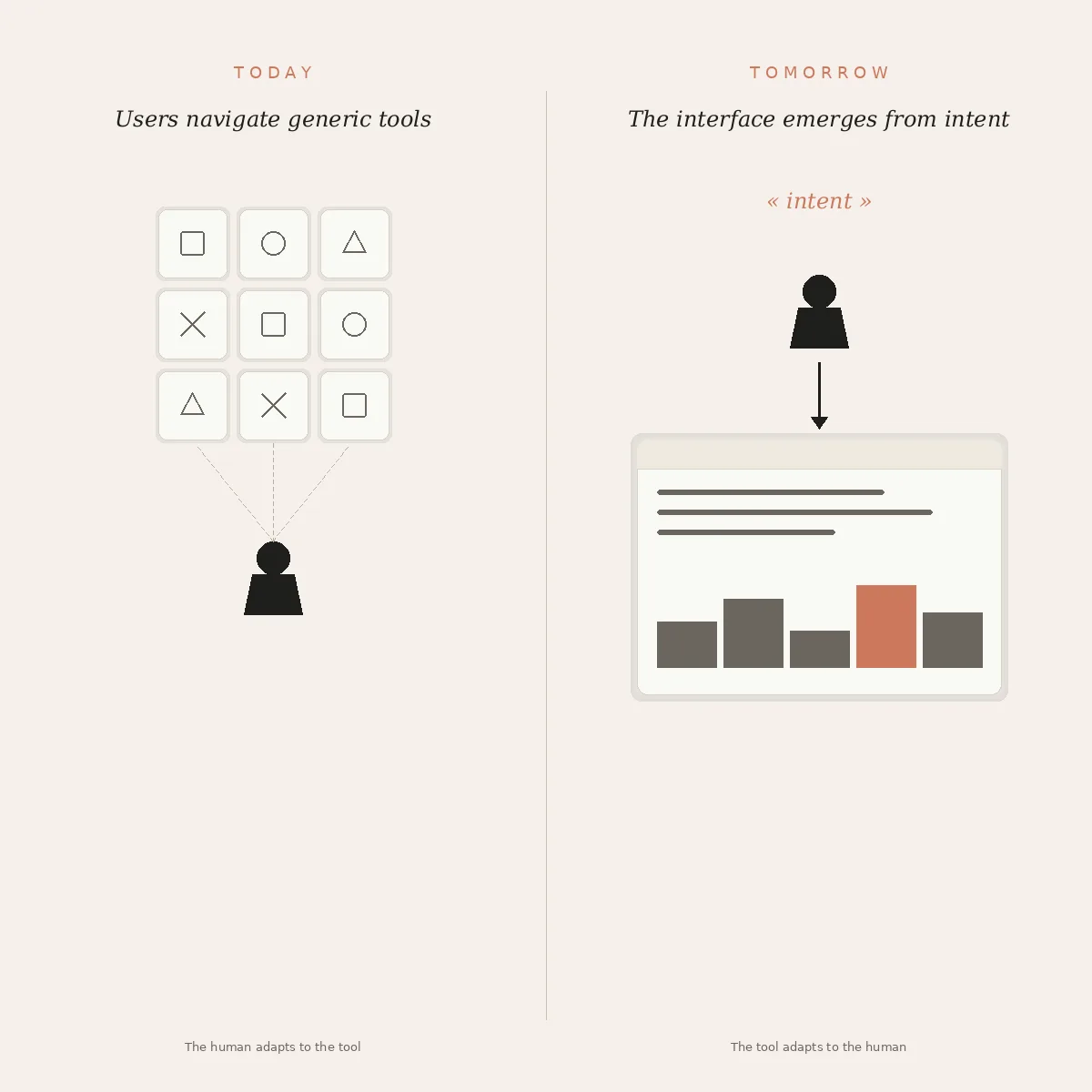
AI changes this equation fundamentally. For the first time, a system can understand what you are trying to accomplish without you having to phrase your request in the vocabulary of a specific application. It can manipulate your data without you having to learn where to click. Above all, it can produce the interface suited to your specific context rather than making you navigate an interface designed for everyone.
Generic, standardized software locked in its format suddenly becomes the exception rather than the norm. And when you start to see this shift, you realize that the essence of what we call “the software industry” rests on a paradigm that is quietly collapsing under our feet.
Software Organized by Intent
If today’s software is organized by output format, what emerges next will be organized by intent. This is a complete philosophical reversal, and it is likely the most profound change since the graphical user interface appeared in the 1980s.
Today, to track the expenses of a renovation project, you open a spreadsheet. To plan a trip, you open a calendar, a map, a booking site, a notes document. To organize a personal collection, you open a database or a specialized application. Each intent forces you to navigate a catalog of generic tools, to choose the one that comes closest to your need, and to bend your intent to its form.
Tomorrow, this navigation will disappear. You will express the intent — track the expenses of this renovation, plan this trip with this family, organize this collection according to your criteria — and the interface will materialize, specific to your context, to your data, to your moment. When the need fades, the interface will fade with it.
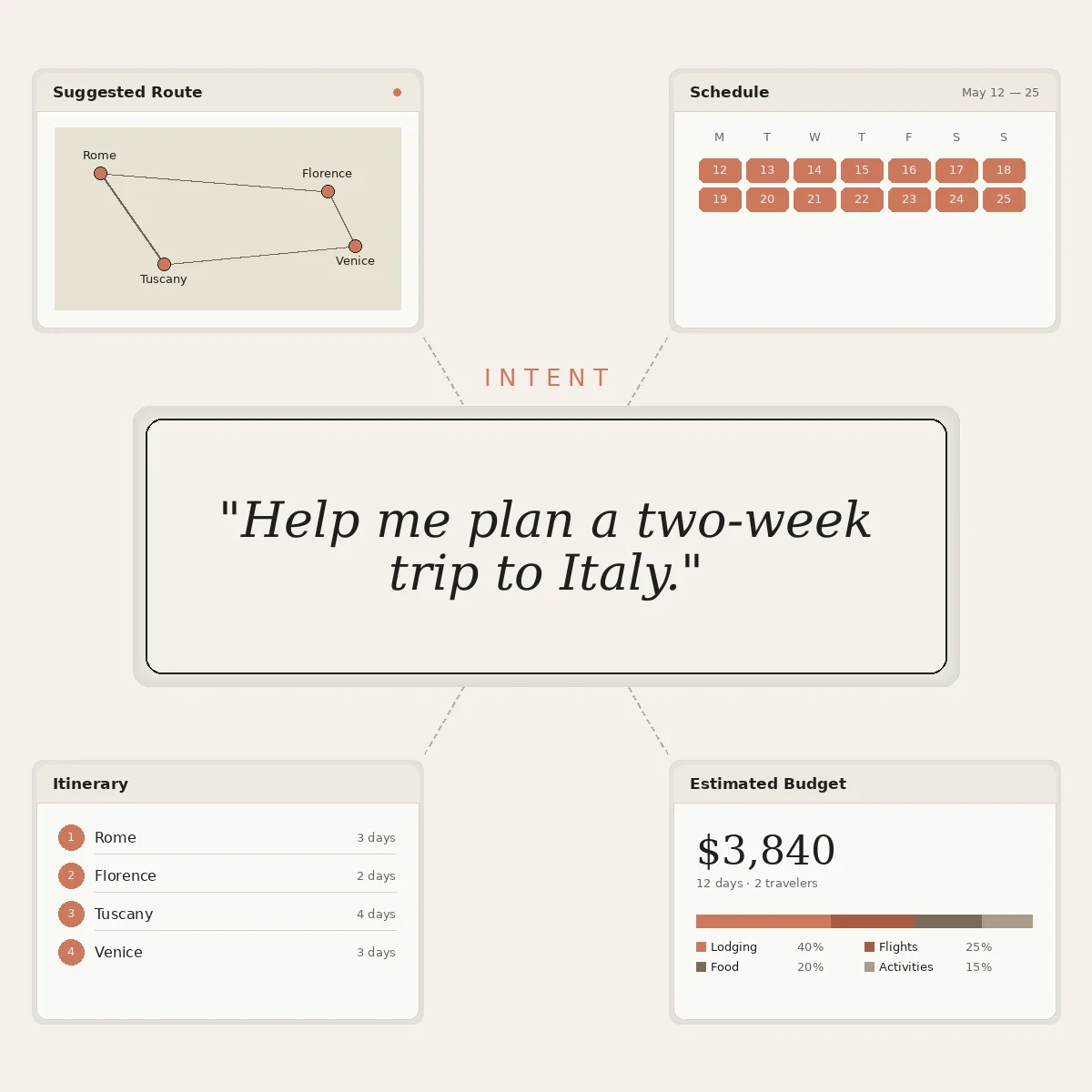
It will never have been a product. It will have been a conversation turned visual.
Applications as we know them will then cease to be destinations, places we go to accomplish a task, and will become invisible capabilities, invoked by intent. Software will no longer be something you “open.” It will be something that appears when you need it, shaped for the precise situation you find yourself in.
Some consumer tools are beginning to sketch this direction. They generate visualizations on demand, compose documents on intent, orchestrate actions across multiple sources. These sketches are real and important — they prove the technology is ready. But they remain trapped inside the paradigm they are trying to transcend: they live inside a chat window, ephemeral, without memory, without possibility of ownership by the user. We can glimpse what is coming through them, the way we could glimpse the smartphone through the first Palm or BlackBerry devices. But the tool these sketches prefigure is still to be built.
This approach resolves a tension the industry has never been able to resolve: the one between the tool that adapts and the tool one masters. When a configuration pleases us, we save it. It becomes our tool, not a generic one. Our own travel planner, which knows our preferences, our family constraints, our booking habits. Not a platform designed to treat everyone the same way. Gradually, each of us accumulates a library of tools that resembles us, some used every day, others once a year, all perfectly adjusted to a unique way of thinking.
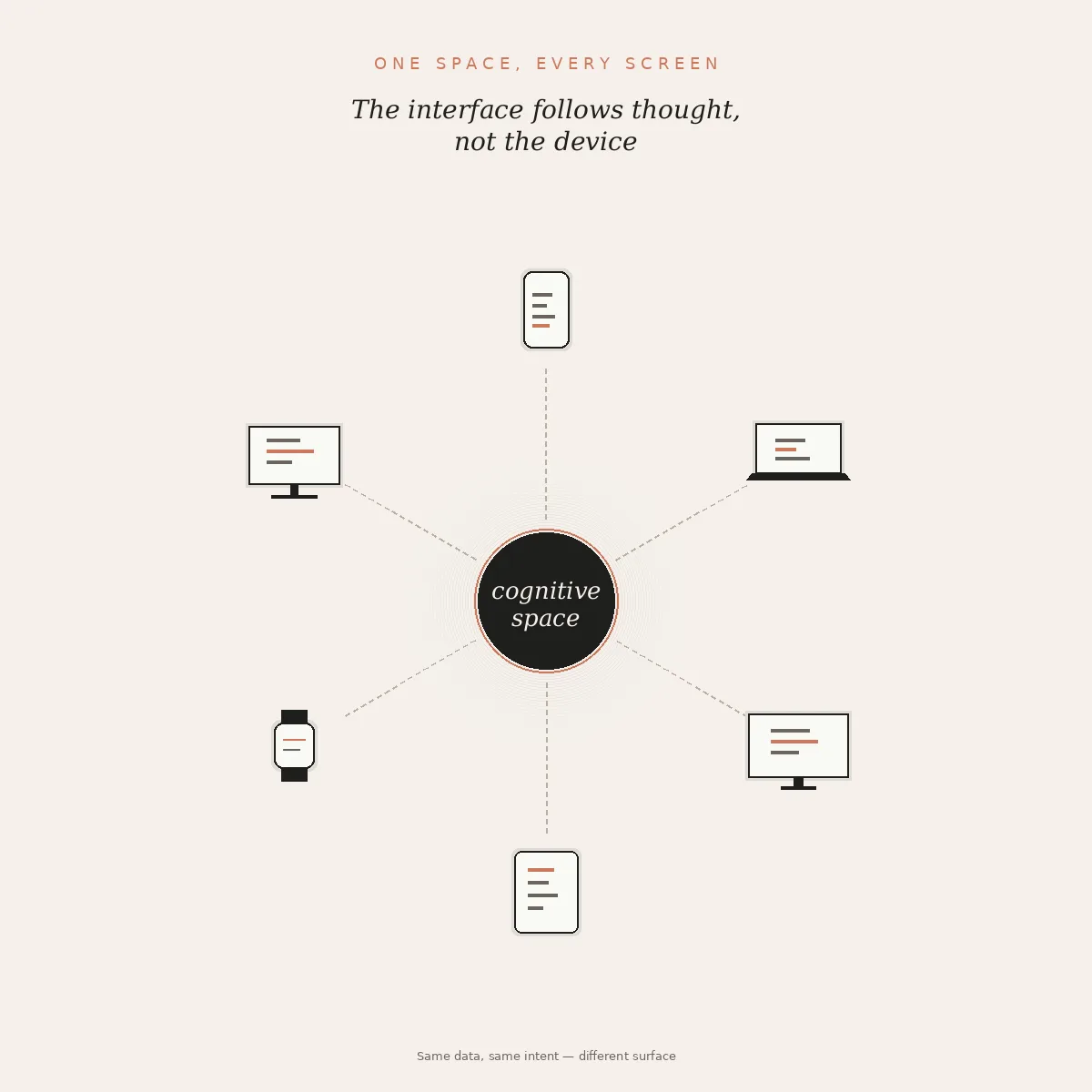
The physical screen, in this world, returns to what it is geometrically: a rectangle that displays pixels. The phone ceases to be fundamentally different from the tablet, from the laptop, from the living room television. Your cognitive space projects onto any available surface, and reconfigures itself for that surface. The living room television becomes a family dashboard in the morning, a cinema in the evening, a visualization tool when you want to show an itinerary to someone. No app to install, no account to sync, no “TV version” or “mobile version.” Just you, your data, and a screen to manifest them.
The Question of Sovereignty
Everything preceding could sound like a technological utopia. It would be a mistake to read it that way.
For a tool to become an extension of thought, it must understand thought. It must observe what you search for, what you save, what you discard, what wastes your time. It must know your data, your habits, your conversations, your failures. The cognitive space that emerges is, by construction, the most intimate digital artifact a human has ever entrusted to a machine. Far beyond what a phone represents today.
The question then becomes not technical but political. Who owns this space? Who has access to it? What happens when the company providing it changes direction, goes bankrupt, or decides to monetize it? What happens when a government wants access to it?
A cognitive space centralized in the servers of a handful of actors is a dangerous object — whether well-intentioned or not.
If this new layer is built according to the model that has dominated for twenty years — the one where major platforms “lease” users access to their own digital lives in exchange for their data — then the transformation will not be liberating. It will be the completion of dependency rather than its resolution.
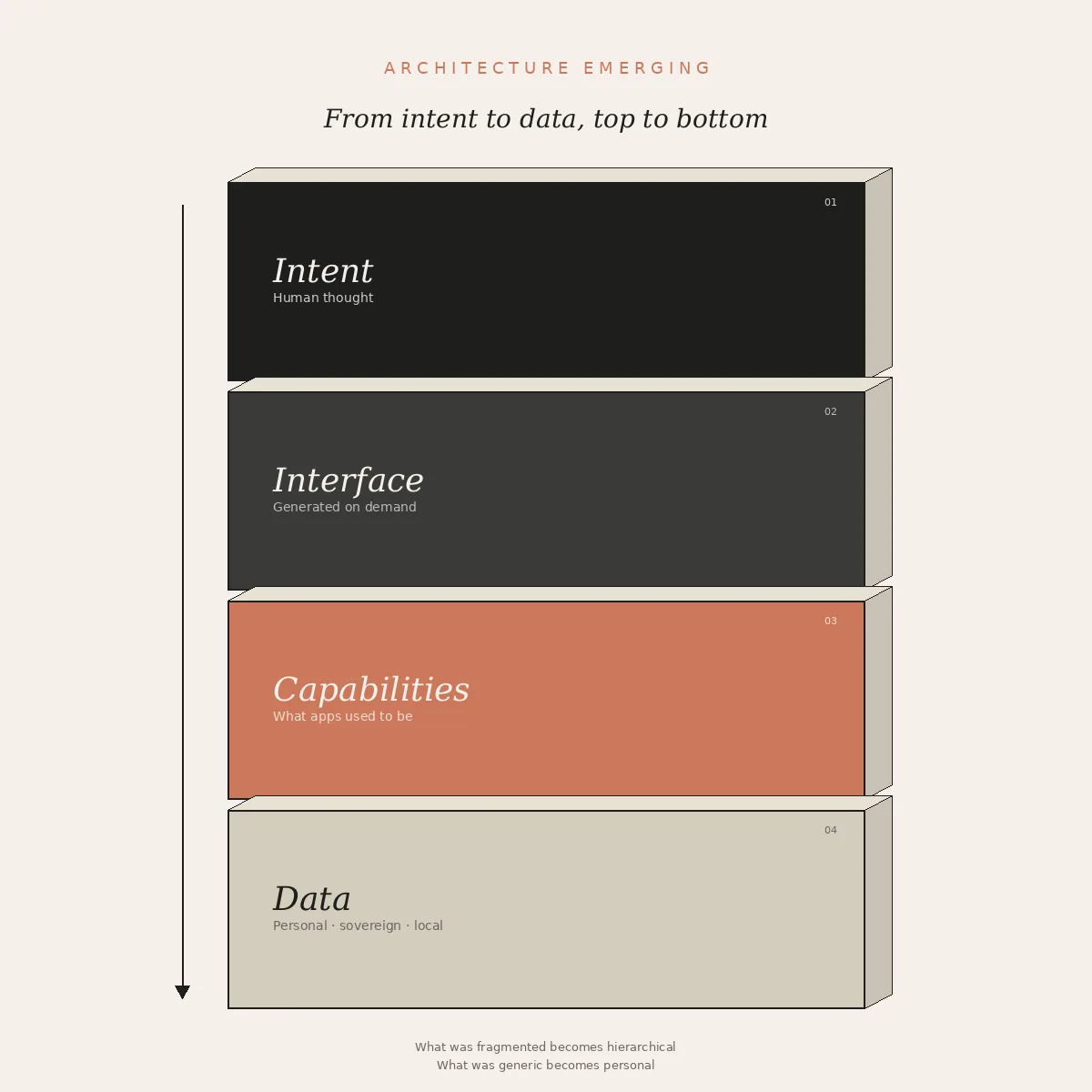
The healthy version of this vision rests on different foundations. AI models that run locally, on the user’s hardware. Data that never leaves the personal perimeter except by explicit choice. An architecture where the user genuinely owns their space, rather than being invited into it by a distant landlord. These principles are not idealism — they are becoming technically possible now, with local models rapidly catching up to their cloud equivalents and with consumer hardware capable of running them.
The battle ahead is therefore not only between the actors who will build this new layer. It is between two philosophies of what it means to own a digital tool. And that battle will largely play out before the general public realizes it is happening.
A Personal Note
Fifteen years ago or so, I proposed to a company a web project whose homepage was nothing but a conversational text field. The idea was to break down all corporate content into semantic units — the smallest coherent piece of information — and let an algorithm assemble the response suited to each question asked. Someone asking for our full address received the full address. Someone asking only for the province received only the province. Information reconfigured itself according to intent.
The prototype worked. The architecture held up. The project never came to fruition, for reasons that had to do with execution rather than vision. But what I remember most is the look on the faces of the people I presented the idea to. A mix of polite incomprehension and open skepticism. As if I were telling them about a car that drives itself.
Today, it is the norm the industry is moving toward. What seemed disconnected was simply premature. What I was trying to do manually with a rigid algorithm back then, neural networks do today with a fluidity that far exceeds what I had imagined.
The paradigms that seem absurd today are often the ones that will feel obvious tomorrow. The opposite is also true.
I don’t tell this story to claim paternity — dozens of people had similar intuitions at the same time, and none of them carried them all the way through. I tell it because it illustrates a principle that seems worth keeping in mind: the difficulty, always, is distinguishing between the two in the moment they present themselves.
What Comes Next
The transition will probably not be gradual. The actors who dominate today’s software industry are structurally incapable of cannibalizing their own models. Their revenues, their ecosystems, their market positions rest precisely on the architecture that is becoming obsolete. Asking a platform that makes its living on app installations to render apps useless is like asking a species to engineer its own extinction.
That is why the rupture, when it comes, will likely come from elsewhere. From actors who have nothing to defend, or from actors who have understood that it is better to render one’s own model obsolete before someone else does. Platform transitions in the history of computing have always followed this pattern: slow incubation, then rapid collapse once the value gap becomes too obvious to ignore.
The real question, then, is not whether this transformation will happen. It is already underway, in research labs, in API specifications, in the intuitions of those who are building. The question is who will carry it and according to which philosophy. A personal, sovereign, local cognitive space will not emerge by default. It will have to be wanted, built, and defended against competing models that will be easier to deploy but more costly in the long run for each individual’s autonomy.
The software industry as we know it is not eternal. It is simply contemporary. What will replace it is already being drawn.